
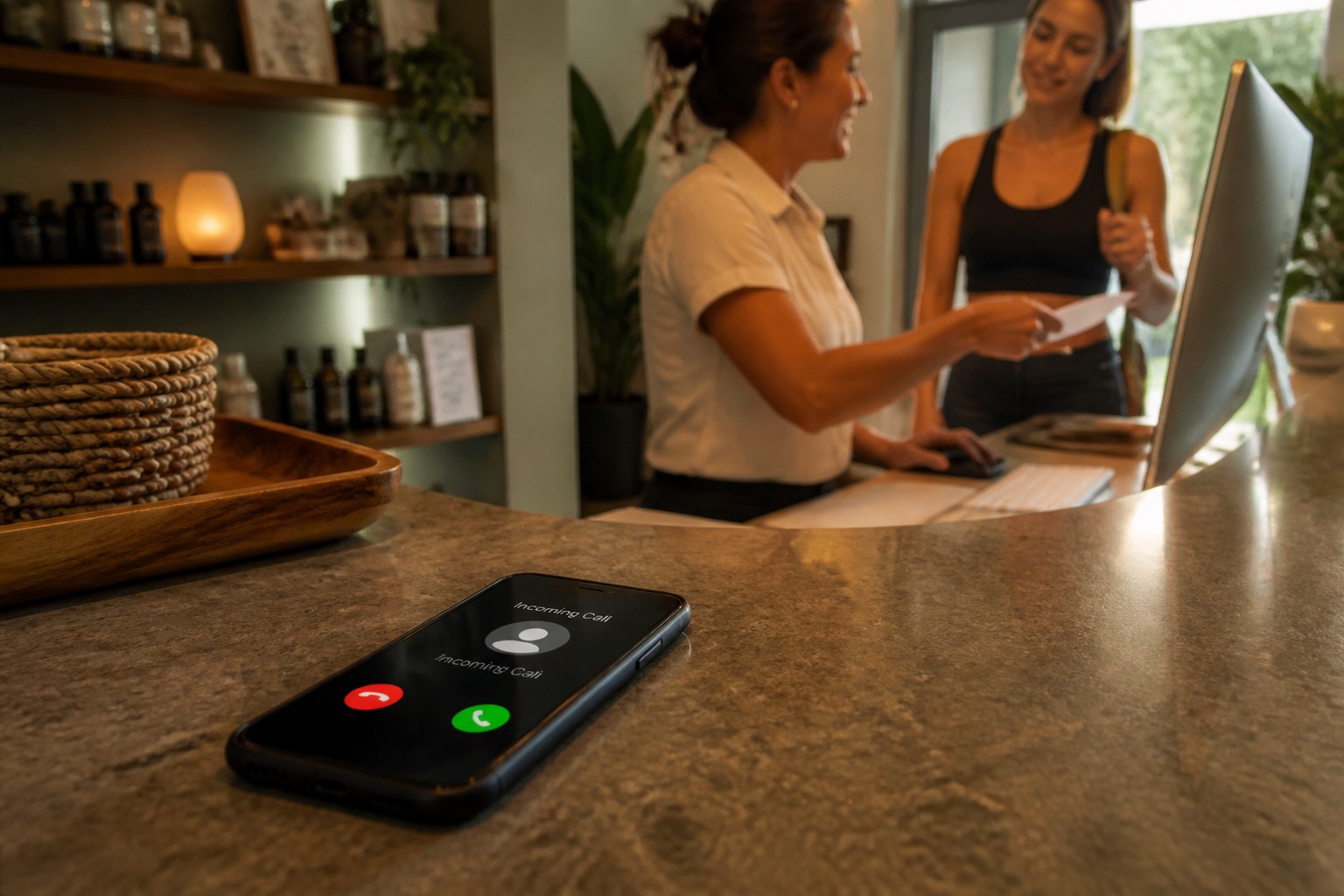
A missed business call is not automatically a lost customer. But when someone is comparing several providers at once, the first useful answer has an advantage. Google's AI calling feature makes that comparison faster and gives an unanswered call less time to recover.
Customers do not care whether a human, a search engine, or another assistant made the first call. They care whether your business gave them a clear answer while the need was active.
The old assumption about voicemail
A technician is under a sink. A receptionist is helping a customer at the counter. A clinic team is between appointments. The phone rings, nobody can reach it, and the call rolls to voicemail.
The old assumption is that the caller will leave a message and wait. Sometimes they do. Often they continue down the list because the problem still needs to be solved.
That basic behavior is not new. What is new is the speed and scale of the comparison. As explained in our guide to Google's AI calling feature, one customer can now ask Google to contact several businesses for prices and availability. The customer does not have to make each call personally.
Google's Search Help documentation says it calls multiple providers and emails the user with the quotes it collects. The customer can receive a usable shortlist in roughly the time it takes to finish lunch.
The important moment is the comparison window
Consider a homeowner who needs a plumber for a leaking kitchen sink. The exact price depends on the fault, access, parts, and urgency. A responsible plumber may not promise a final total over the phone.
That does not mean the business has nothing useful to say. It can confirm the service area, state the diagnostic fee, explain when a technician is available, and describe how the final quote is approved.
Now put that business beside two competitors:
- Business A answers: It confirms the ZIP code, the visit fee, and a same-day window.
- Business B reaches voicemail: No current price or availability is collected.
- Business C answers poorly: The person sounds rushed and says to call back later.
The customer is not evaluating phone etiquette in isolation. They are trying to decide who can help. Business A makes the next step easy.
The missed opportunity is not the ringing phone. It is the unanswered question behind it.
Why voicemail is weaker in an AI-assisted search
It returns no structured answer
Google's automated caller is trying to complete a task. It needs information it can summarize, such as availability, a price range, a service policy, or a booking path. A generic greeting provides none of those.
It makes the customer do the work again
The customer already described the job in Google's form. If they must repeat everything in a voicemail and wait for a callback, the convenience of the AI comparison disappears. A competitor that answers can move forward immediately.
It creates uncertainty
Is the business closed, overwhelmed, outside the service area, or simply away from the phone? The customer does not know. In a side-by-side comparison, uncertainty is usually less attractive than a clear next step.
Independent reporting from Near Media found that only some of the businesses contacted during its tests returned useful responses. It was a small test, not a universal success rate. Still, it demonstrates that being called and being represented in the final information are separate outcomes.
A better answer does not need to promise too much
Some owners hear "AI price comparison" and assume they must publish a low fixed price for every job. That would be a mistake for businesses where scope varies.
A good phone answer can be precise about the process without pretending the final price is known:
"We handle that type of repair in your area. The visit starts with our standard diagnostic fee, and the technician gives you the full price before work begins. We have an opening tomorrow afternoon."
The amount in that example must come from the business. The structure is what matters: fit, pricing policy, availability, and next step.
Google's guidance for business owners says that sharing information related to a customer request can encourage a visit or purchase. It also lets businesses turn automated calls off. That control is useful, but opting out does not solve the customer expectation behind the feature. People still want an answer.
An AI receptionist is useful when it protects the answer
The case for an AI receptionist is not that every conversation should be automated. It is that routine, high-intent questions should not depend on one busy person reaching the phone.
A well-prepared receptionist can:
- answer during busy periods and after hours;
- recognize the requested service and location;
- use approved price ranges, fees, and policies;
- check availability or collect a preferred time;
- transfer urgent or sensitive calls to a person;
- record what was asked and what happened next.
The quality depends on the rules behind it. An AI receptionist that invents a price is worse than voicemail. One that knows its boundaries can make the business reachable without exposing it to promises the team cannot keep.
Measure outcomes, not just call volume
Answer rate is useful, but it is only the beginning. A business should also know whether the call produced a qualified inquiry, a booking, a transfer, or a clear follow-up.
Start with four questions:
- How many calls arrive while the team is already busy?
- How many arrive outside normal hours?
- Which questions repeat most often?
- What is the expected next step for each type of call?
Those answers create the call playbook. They also reveal where automation is useful and where a person should remain in control.
The best time to prepare is before the next call
Google did not invent impatient customers. It removed more of the effort from comparing businesses. That makes responsiveness visible in a new way.
You do not need to replace your team or make every price public. You need a reliable response path that works when the caller is ready and your staff is not free.
For many local businesses, this is the right moment to evaluate an AI receptionist that can work from real business rules. The goal is simple: give each good call somewhere useful to go.